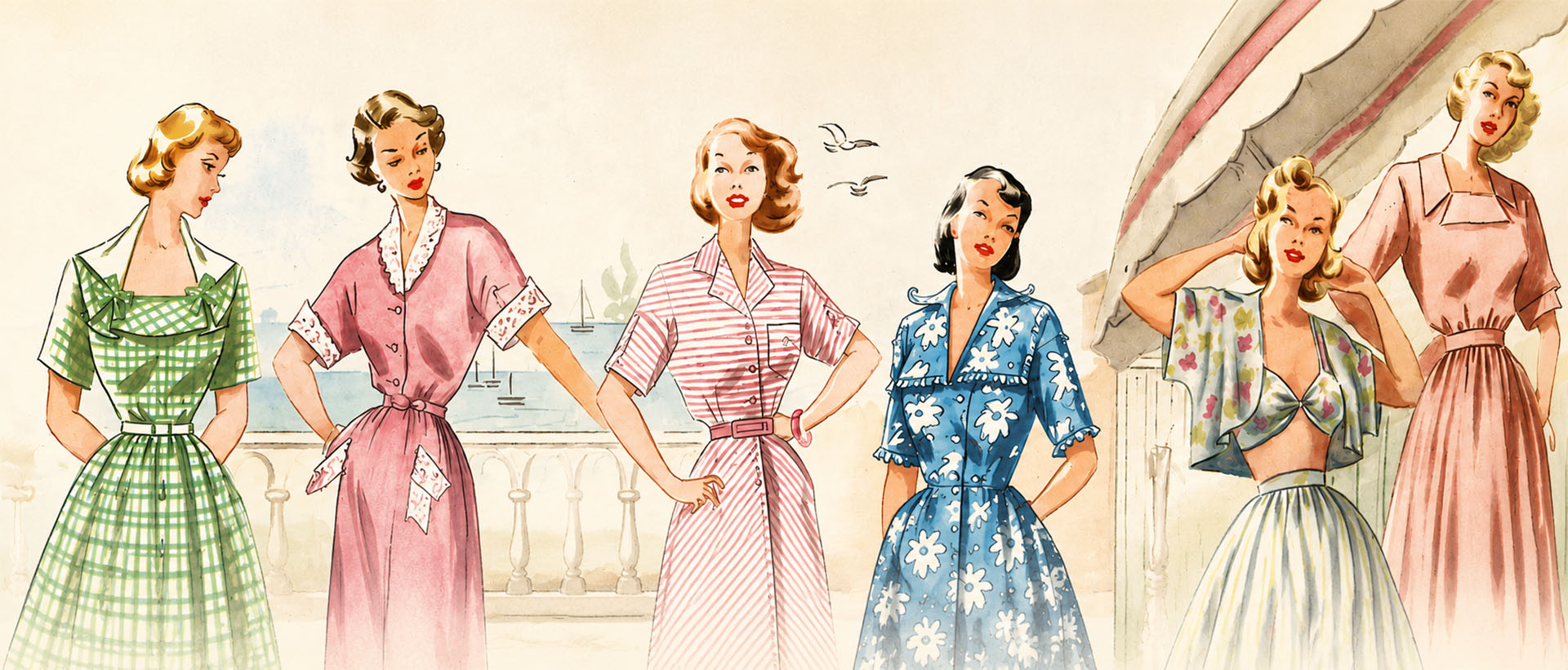
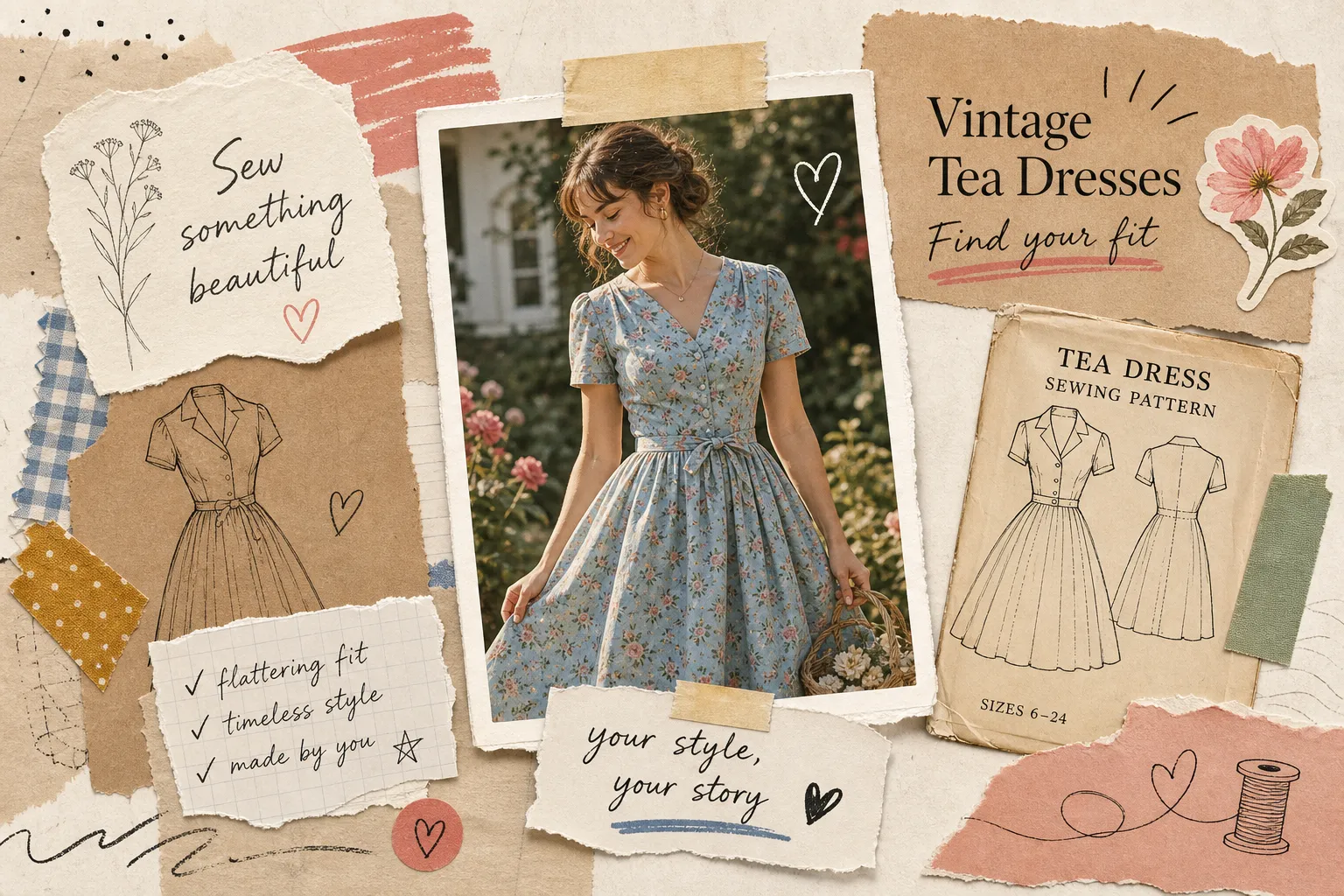
It usually starts with a photograph. Maybe it’s a grandmother in a garden, wearing a dress that buttons from neck to hem and skims her figure in a way that feels effortlessly elegant.
Maybe it’s a scene from a film set in the 1940s, or a vintage magazine you stumbled across in a charity shop. Wherever you first saw it, a tea dress has a way of staying with you.
And then you go looking for a vintage tea dress sewing pattern, and suddenly there are three decades of options, a choice between paper and PDF, fabric recommendations that
assume you already know what viscose lawn feels like, and size charts that bear little resemblance to the labels hanging in your wardrobe. It’s a lot. The good news is that once you
understand what actually differs between the eras and what a pattern is genuinely asking of you, the whole thing becomes far more manageable.
Choosing a vintage tea dress sewing pattern isn’t just about picking whichever style photograph you like best. It’s about matching the design to your current skills, the fabric you enjoy
working with, and the silhouette that will actually suit your body.
This guide walks you through all of it, from understanding the differences between a 1930s bias-cut dress and a 1950s full-skirted design, to choosing fabrics, navigating vintage sizing,
and finding a pattern you’ll genuinely enjoy sewing.
Quick Answer: Which Vintage Tea Dress Pattern Should You Choose?
If you’re new to vintage sewing, a 1940s tea dress pattern is usually the easiest place to start. The construction is often simpler, the fit is forgiving, and the techniques are approachable
for beginners. If you love soft drape and romantic details, a 1930s tea dress may be worth the extra challenge. If your dream dress involves a fitted waist and a full skirt that swishes
beautifully when you walk, you’ll probably find yourself drawn to the 1950s.
| Era | Style | Best For | Difficulty |
|---|---|---|---|
| 1930s | Soft drape, bias-cut elegance | Romantic vintage styling | Intermediate |
| 1940s | Practical yet feminine | First vintage sewing projects | Beginner |
| 1950s | Defined waist and full skirt | Classic vintage glamour | Intermediate |
For most sewists, the best pattern isn’t necessarily the most beautiful one. It’s the one that matches your current experience and gives you the best chance of ending up with a dress
you’ll actually wear.
The 1930s, 1940s and 1950s Tea Dress: What’s the Difference?
The term “tea dress” gets applied to an enormous range of styles, but the silhouette shifted quite significantly across these three decades. Understanding those differences before you
buy a pattern can save a surprising amount of time, money and frustration. Each era’s construction reflects the fashions, fabrics and practical realities of its time. That affects not just
how the finished dress looks, but how straightforward it is to sew.
1930s Tea Dress Sewing Patterns: Bias-Cut Softness and Romantic Florals
A 1930s tea dress is recognisable by its fluid, body-skimming quality. Fabric cut on the bias, roughly 45 degrees to the grain, creates that characteristic drape. Rather than being
structured around the body, the dress follows the figure gently and naturally.
You’ll often find:
- Lower natural waistlines
- Longer hemlines
- Delicate floral prints
- Lace collars and cuffs
- Soft gathers and flutter sleeves
- Elegant V-necks and cowl necklines
The result is incredibly feminine and surprisingly modern. Many contemporary designers still borrow heavily from 1930s silhouettes because they flatter so many body shapes. The
catch is that bias-cut fabric behaves differently. It stretches more easily, shifts during cutting, and can distort if handled carelessly. Hems often need to hang for 24 hours or longer
before finishing because the fabric continues to settle under its own weight. For that reason, a 1930s tea dress sewing pattern tends to suit sewers who have already completed a
few garments and feel comfortable taking their time with the process. The extra effort is often rewarded with some of the most elegant dresses ever created.
1940s Tea Dress Patterns: Practical Elegance in a Utility Silhouette
For many people, the 1940s offers the perfect balance between style and simplicity.
Wartime rationing influenced fashion in surprisingly useful ways. Fabric restrictions encouraged designers to simplify construction, reduce excess fullness and focus on efficient cutting
layouts. The result was a silhouette that remained feminine while becoming considerably more practical.
You’ll frequently find:
- Natural waistlines
- Button-front openings
- Wrap-style designs
- Simple bodice shaping
- Modest skirt fullness
- Shirt-dress influences
- Fewer pattern pieces
These cleaner lines make 1940s tea dress patterns some of the most beginner-friendly vintage garments you can sew. Many also adapt beautifully to modern life. A 1940s tea dress
can feel just as appropriate for a weekend lunch, office environment or summer event today as it did eighty years ago. If you’re making your first vintage dress, this is often the
smartest place to start.
1950s Tea Dress Patterns: Full Skirts and Nipped Waists
The 1950s brought a dramatic shift in silhouette. A fitted bodice, a defined waist and a full skirt became the defining look of the decade. It’s the style most people picture when they
think of vintage fashion today. These dresses are wonderfully flattering and immensely satisfying to sew.
Typical features include:
- Fitted bodices
- Full gathered skirts
- Circle skirts
- Waistbands and midriff panels
- Structured shaping
- Back zip closures
- Decorative collars and cuffs
A 1950s tea dress often requires more fabric than earlier styles, but that’s part of its appeal. The generous skirts create movement and drama that’s difficult to achieve in any other
decade. Construction is usually more involved too. A typical 1950s tea dress pattern may include a lined bodice, waist seams, midriff bands, zips and more precise fitting requirements.
Intermediate sewers often find the extra effort worthwhile once they see the finished result.
How to Choose a Vintage Tea Dress Sewing Pattern You’ll Actually Finish
The most common reason a sewing project stalls isn’t lack of skill. It’s choosing a pattern for its photograph rather than its construction requirements. We’ve all done it. A beautiful
envelope illustration convinces us that this dress will somehow be different. Then the instructions arrive, the pattern pieces cover the dining table, and suddenly we’re looking at
techniques we’ve never encountered before. Being honest about where you are right now isn’t limiting. It’s how you end up with a finished dress hanging in your wardrobe rather
than a half-cut project sitting in a basket.
What to Look for as a Beginner
Beginner-friendly tea dress patterns tend to share a few specific features.
Look for:
- Simple darted bodices
- Standard zip closures
- Wrap-style construction
- Elasticated waists
- Minimal lining
- Few pattern pieces
These details reduce complexity and allow you to focus on learning core garment-sewing skills.
Many modern reproduction patterns include skill ratings or technique notes. If yours doesn’t, count the pattern pieces and check whether lining or interfacing is required. Both are
reliable indicators that the pattern expects more than the basics.
Features That Often Signal an Intermediate Pattern
If a pattern includes any of the following, it’s worth having some garment-sewing experience first:
- Invisible or concealed zips
- Button-front plackets
- Bias-cut construction
- Princess seams
- Midriff bands
- Fully lined bodices
- Tailored collars
These are all perfectly learnable techniques, but each is easier when tackled one at a time rather than all in the same project.
How to Read Reproduction Pattern Skill Ratings
Unlike original vintage patterns, which often assumed a fairly high baseline of sewing knowledge, many modern reproduction patterns are designed with contemporary sewers
in mind.
Look carefully at:
- Difficulty ratings
- Fabric recommendations
- Number of pattern pieces
- Required techniques
- Whether fitting guidance is included
A pattern labelled “easy” today would often have been considered a fairly straightforward home-sewing project in the 1940s. That’s good news for beginners. Modern instructions
tend to be far clearer than their historical counterparts.
Paper or PDF: Which Format Works Best?
One decision many sewers face before they even begin is whether to choose a paper pattern or a PDF download. Both have advantages.
When Paper Patterns Make Sense
Many sewers simply enjoy working with paper patterns. There’s something satisfying about unfolding the sheets across a dining table, weighing them down with pattern weights
and cutting directly from the original.
Paper patterns are particularly useful if:
- You dislike assembling tiled PDF pages
- You don’t have access to large-format printing
- You prefer tracing patterns before cutting
- You enjoy collecting vintage sewing materials
A paper pattern also feels closer to the traditional sewing experience.
Why PDF Patterns Have Become So Popular
PDF patterns offer one major advantage: instant access. The moment you buy them, they’re yours. If a pattern piece gets damaged, lost or covered in coffee stains, you simply print
another copy. They’re also usually the more affordable option. The only real drawback is assembly. Printing and taping together dozens of pages is nobody’s favourite sewing task.
Fortunately, many sewers now use local print shops to print patterns at A0 size, which removes the problem entirely for just a few pounds. For many people, PDF patterns from
sellers like My Vintage Wish provide the best combination of convenience, affordability and flexibility.
Fabric Choices for Your Vintage Tea Dress
One of the quickest ways to make a vintage dress look “off” is choosing a fabric that doesn’t suit the design. The silhouette a pattern creates depends heavily on how the fabric
behaves.
Best Fabrics for 1930s and 1940s Tea Dresses
The 1930s and early 1940s tea dress were designed for fabrics that move.
Look for:
- Viscose
- Rayon
- Silk crepe
- Cotton lawn
- Fine voile
- Lightweight challis
These fabrics drape beautifully and create the soft lines associated with these decades. This matters enormously for bias-cut patterns. A stiff fabric on a bias-cut dress often creates
a boxy shape rather than the elegant silhouette the pattern was designed to achieve. If you’re investing time in a 1930s pattern, the fabric choice is every bit as important as the
pattern itself.
Best Fabrics for 1950s Tea Dresses
The 1950s silhouette benefits from a little more structure.
Good choices include:
- Cotton poplin
- Broderie anglaise
- Polished cotton
- Lightweight taffeta
- Cotton sateen
- Lightweight linen blends
These fabrics help skirts hold their shape and create the characteristic swing associated with the decade. For a knee-length 1950s tea dress with a gathered skirt, it’s sensible to
budget for approximately 3.5–4 metres of fabric, particularly if you’re matching prints.
Notions and Supplies You’ll Need
Before cutting into your fabric, check the pattern’s notions list carefully. Most vintage tea dress patterns require:
- Matching thread
- Medium-weight fusible interfacing
- A zip or buttons
- Bias binding
- Hook and eyes
- Optional lace trim
- Pattern weights or pins
- Tailor’s chalk or marking tools
Gathering everything before you start makes the sewing process far more enjoyable and avoids those frustrating mid-project trips to the haberdashery.
Getting a Flattering Fit from a Vintage Pattern
Vintage Sizing Is Not Modern Sizing
This is perhaps the most important thing to remember. Vintage patterns were drafted according to body measurements, not modern retail sizing. A vintage size 16 is not a modern
UK 16. This surprises almost everyone the first time they encounter it. Always choose your size according to:
- Bust measurement
- Waist measurement
- Hip measurement
Ignore the size number completely. The measurements are what matter.
Common Adjustments That Make a Big Difference
Many sewists regularly make:
- Full bust adjustments (FBA)
- Sway-back adjustments
- Bodice length adjustments
- Sleeve length adjustments
- Shoulder adjustments
These alterations are completely normal and don’t indicate a poorly drafted pattern. They’re simply part of adapting historical sizing systems to modern bodies. In fact, many
experienced sewers expect to make at least one or two fitting adjustments before cutting their final fabric.
Why a Toile Is Worth the Effort
If you’re sewing a fitted 1950s tea dress, making a toile can save a great deal of frustration. A toile is a test version sewn from inexpensive fabric before cutting into your final
material. Yes, it takes extra time. But it often reveals fitting issues that would be far more difficult to correct later. Think of it as insurance for your favourite fabric.
Where to Find Vintage Tea Dress Sewing Patterns in the UK
There are more options available today than ever before. Original vintage patterns occasionally appear at antique fairs, online marketplaces and charity shops, but they can be
fragile, incomplete and limited to a single size.
For most sewers, reproduction patterns offer the best balance of authenticity and practicality. A good reproduction pattern provides the charm of the original design while
incorporating clearer instructions and more accessible sizing.
My Vintage Wish is one option worth exploring, particularly if you’re interested in historically accurate designs from the 1920s through to the 1960s. The collection includes both
paper and PDF formats and covers a wide range of skill levels.
Whether you’re looking for a simple 1940s day dress or a more ambitious 1950s full-skirted design, reproduction patterns make vintage sewing considerably more accessible than
it once was.
Frequently Asked Questions
Are vintage tea dress sewing patterns suitable for beginners?
Yes. Many 1940s tea dress patterns are excellent beginner projects because they use simpler construction methods and fewer pattern pieces than many 1930s or 1950s designs.
How much fabric do I need for a vintage tea dress?
Most tea dresses require between 2.5 and 4 metres of fabric depending on the skirt style, your size and the fabric width.
What’s the difference between a tea dress and a swing dress?
Tea dresses are generally daytime dresses with feminine silhouettes and practical details. Swing dresses usually refer to fuller-skirted 1950s styles designed to move dramatically
when worn.
Can vintage sewing patterns be adjusted to modern sizes?
Absolutely. Most reproduction patterns are already graded into modern size ranges, while original vintage patterns can be altered using standard fitting techniques.
Are PDF sewing patterns worth it?
For many sewers, yes. They offer instant access, lower prices and the ability to reprint pieces whenever needed.
Ready to Start Sewing?
Choosing a vintage tea dress sewing pattern comes down to a few honest questions. Which era genuinely excites you? Which techniques are you comfortable with right now? Which
fabrics feel like a pleasure rather than a challenge? Once those answers are clear, the right pattern becomes much easier to spot. You’re not looking for the prettiest photograph.
You’re looking for the design that matches where you are as a sewer today.
The thing about tea dresses is that every one you make teaches you something the next one benefits from: a neater zip, a better-fitting bodice, a more confident fabric choice. Start
wherever feels right. The next dress will always be even better.