
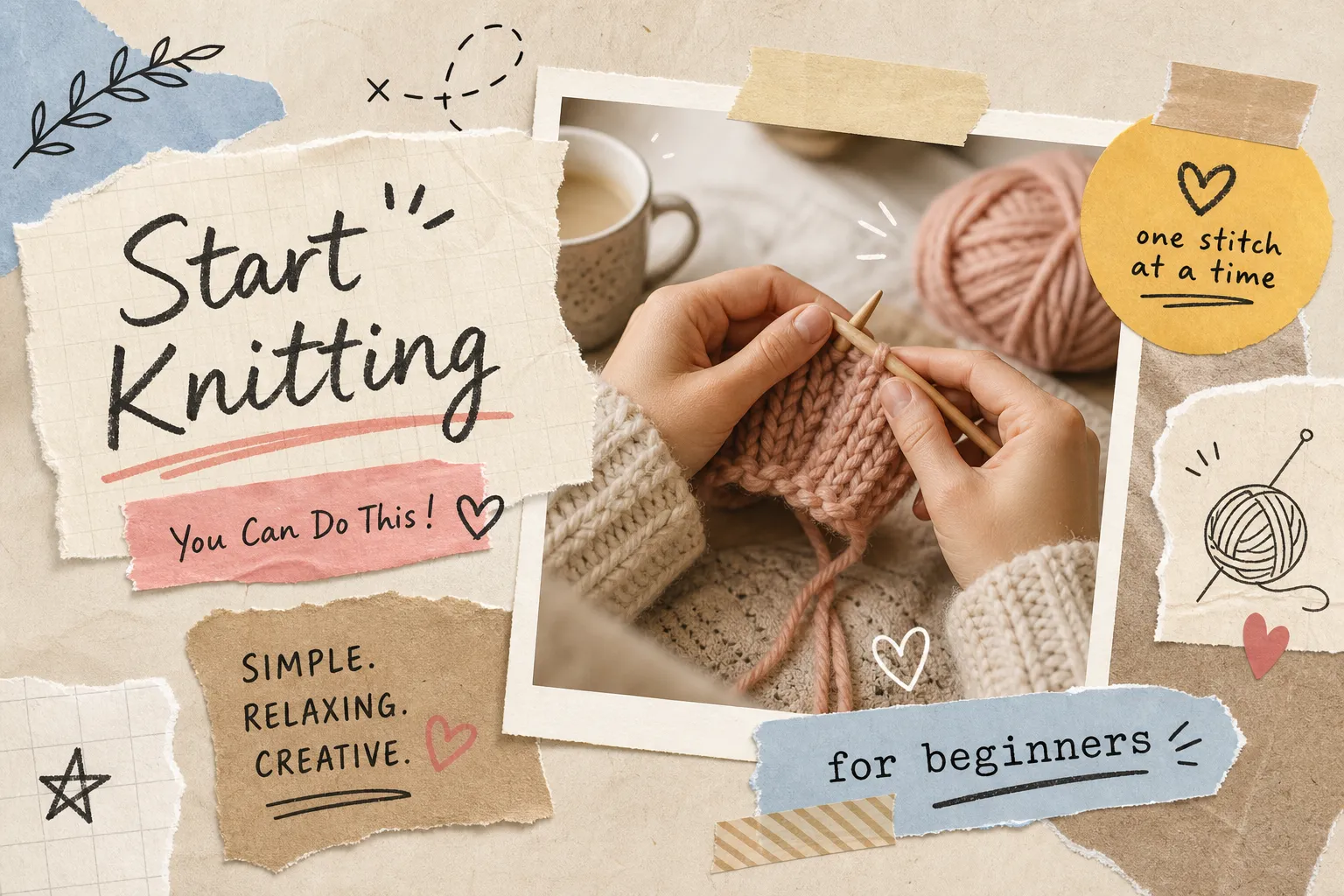
Learning to knit is easier than most people think.
The problem isn’t that knitting is difficult. It’s that beginners are often given too much information too soon. One minute you’re buying your first ball of yarn, the next you’re reading about
tension squares, circular needles, yarn weights and pattern abbreviations.
In reality, every knitting project starts with just four basic techniques: cast on, knit, purl and cast off.
At My Vintage Wish, we’ve spent years working with vintage knitting patterns from the 1920s through to the 1970s, and we’ve noticed something interesting. The knitters who make the
fastest progress aren’t necessarily the most talented. They’re the ones who focus on the basics first and leave everything else for later.
This guide will show you exactly what you need to start knitting, the beginner mistakes to avoid, and how to build enough confidence to tackle your first real project.
Quick Start: Learn to Knit in 5 Steps
If you want the shortest possible version:
- Buy 5mm bamboo knitting needles.
- Choose a light-coloured DK or Aran yarn.
- Learn to cast on.
- Practise knit and purl stitches on a small swatch.
- Make a simple scarf or dishcloth.
That’s the foundation of knitting. Everything else builds from there.
What You Need to Start Knitting
One of the biggest mistakes beginners make is buying too much equipment. You do not need a cupboard full of needles, dozens of stitch markers or a collection of specialist tools.
For your first project, you’ll need:
- A pair of 5mm bamboo knitting needles
- DK or Aran yarn in a light colour
- Small scissors
- A tapestry needle
- A few stitch markers
That’s it.
Why We Recommend Bamboo Needles
Many experienced knitters enjoy using metal needles, but beginners often find bamboo easier to control.
The slight grip of bamboo helps keep stitches on the needle, reducing one of the most common frustrations new knitters experience: accidentally dropping stitches before they mean to.
Choosing Your First Yarn
A smooth DK or Aran yarn is ideal. Light colours make it easier to see individual stitches and spot mistakes. One mistake we see repeatedly is beginners choosing fluffy or textured yarn
because it looks attractive in the shop. Unfortunately, these yarns hide the stitch structure and make learning far harder than it needs to be. For your first project, simple is better.
The Four Skills Every Beginner Needs
Nearly every knitting pattern, whether it’s a simple scarf or a fitted 1950s cardigan, is built from four core techniques.
1. Cast On
Casting on creates your first row of stitches.
There are dozens of cast-on methods, but beginners only need one. The long-tail cast-on is widely used, easy to learn and suitable for most projects. Don’t worry about speed. Focus on
creating evenly sized stitches and becoming comfortable with the movement.
2. Knit Stitch
The knit stitch is the foundation of knitting.
Insert the right needle into the front of the stitch, wrap the yarn around the needle, pull a loop through and slide the old stitch off. When you knit every row, you create garter stitch. Many
first scarves are made entirely from garter stitch because it’s simple, attractive and forgiving of small mistakes.
3. Purl Stitch
The purl stitch is often described as the opposite of the knit stitch. Once you learn both techniques, an enormous number of stitch patterns become available. Alternating knit and purl
rows creates stocking stitch, the smooth fabric used in most knitted garments.
4. Cast Off
Casting off secures your stitches and finishes your work. Many beginners cast off too tightly, creating an edge that pulls and puckers. Try to maintain the same relaxed tension you’ve used
throughout the project.
The First Thing You Should Knit
Most guides immediately recommend a scarf. We disagree. A small practice swatch is actually a better first project. Cast on around 15 stitches and knit a small square. In less than 30 minutes
you’ll practise:
- Casting on
- Knit stitches
- Purl stitches
- Casting off
More importantly, you’ll make your first mistakes on something that doesn’t matter. That takes away much of the pressure beginners feel. Once you’ve completed a swatch, move on to a scarf,
dishcloth or simple cowl.
The 5 Beginner Mistakes We See Most Often
One advantage of working with knitting patterns for many years is seeing the same problems appear again and again. Fortunately, most beginner mistakes are easy to fix.
1. Choosing Difficult Yarn
Fancy yarn is tempting. Resist it. Smooth yarn lets you see what you’re doing. Fluffy yarn hides mistakes until they’ve become much larger problems.
2. Pulling Every Stitch Too Tight
Many new knitters assume tighter stitches mean better knitting. In reality, tight knitting often makes projects harder to complete because inserting the needle becomes difficult.
Relax your grip and let the needles do the work.
3. Ignoring Stitch Counts
If your project is supposed to have 20 stitches, count them regularly. A changing stitch count is one of the clearest signs that something has gone wrong.
4. Starting With a Huge Project
We’ve seen beginners attempt blankets, fitted jumpers and complicated lace projects as their very first piece. Small finished projects build confidence much faster than large unfinished
ones.
5. Being Afraid to Unravel
Experienced knitters unravel their work all the time. Mistakes happen at every skill level. Removing a few rows and correcting an error is a normal part of knitting, not a sign of failure.
How Long Does It Take to Learn Knitting?
Most people can learn the basic knit stitch in a single sitting. After a weekend of practice, many beginners are comfortable enough to complete a simple scarf or dishcloth. The challenge
isn’t learning the movements. The challenge is developing consistency. That comes naturally through repetition.
How to Read Your First Knitting Pattern
Patterns look intimidating because they’re written in shorthand. Some common abbreviations include:
- k = knit
- p = purl
- st = stitch
- sts = stitches
- k2tog = knit two together
- rep = repeat
The good news is that patterns become easier very quickly. After a few projects, most knitters can read abbreviations almost automatically.
A Note About Vintage Patterns
Vintage knitting patterns often contain older terminology and different sizing standards. This can seem intimidating at first, but the actual knitting techniques are usually no more
difficult than those used in modern patterns. In fact, many vintage patterns assume a stronger understanding of basic knitting skills and less reliance on step-by-step instructions.
That’s one reason they remain so rewarding to knit.
When Are You Ready for a Vintage Knitting Pattern?
One question we hear regularly is whether vintage knitting patterns are suitable for beginners. The answer is: sometimes. A beginner who has completed a few scarves, understands knit
and purl stitches, and can follow basic instructions will often be surprised by how accessible many vintage designs actually are.
Simple 1940s scarves, hats and accessories can be excellent stepping stones into vintage knitting. More fitted garments are usually best tackled once you’ve gained some confidence with
shaping and reading patterns.
Frequently Asked Questions
Do I need expensive knitting supplies?
No. A basic pair of bamboo needles and a ball of yarn are enough to learn.
What should my first project be?
A small swatch, followed by a scarf, dishcloth or simple cowl.
What if I drop a stitch?
Every knitter drops stitches occasionally. Learning to recover them is part of the craft and becomes easier with practice.
Do I need to make a tension swatch?
For scarves and simple accessories, not necessarily. For garments, absolutely.
Final Thoughts
Every experienced knitter started exactly where you are now: holding a pair of needles and wondering where to begin. Focus on the four core skills. Practise on a small swatch. Choose
simple projects that allow you to finish successfully. Most importantly, don’t let mistakes discourage you. They’re part of learning. Once you’ve mastered the basics, an entire world of
knitting opens up, from simple accessories to intricate lacework and the timeless designs found in vintage knitting patterns. The next stitch is the only one that matters.